
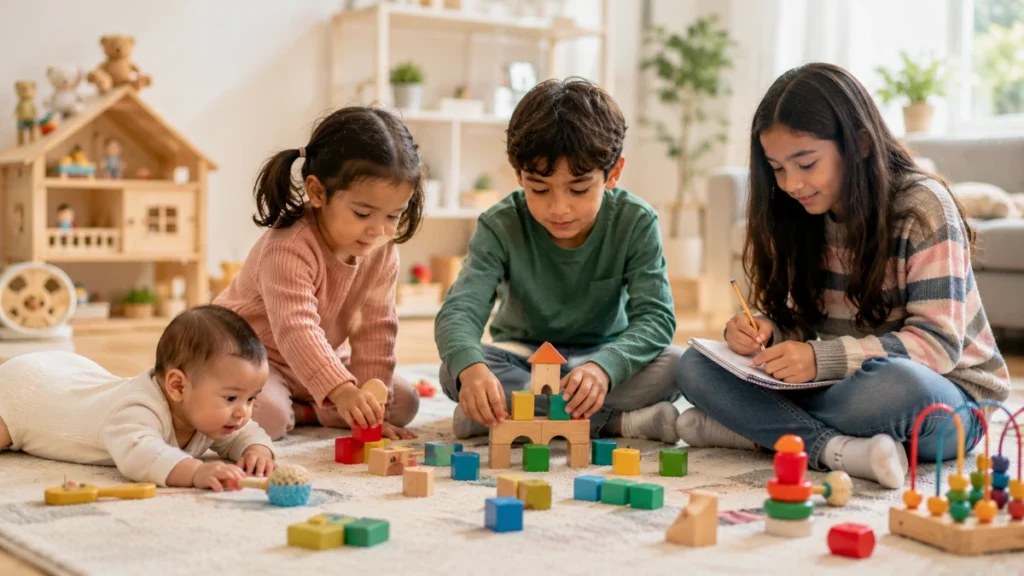
Childhood Development Stages: : A Parent’s Complete Guide
From first smiles to college plans – every stage of childhood matters. Here’s what to expect, and how to show up for each one.
Why Developmental Stages Matter- and What They Can’t Tell You
In over a decade of working with children and families, one of the most common things I hear from parents is some version of: “Is my child normal?” It’s a question that comes from love and from the very human need to know that things are going well. Developmental stages are the framework we use to answer that question, but they require careful reading to be genuinely useful.
Developmental science studies patterns across large populations of children. What emerges are milestone windows — broad age ranges during which most children acquire particular skills, behaviours, or capacities. These windows are meaningful. A child who is not babbling by nine months, not walking by eighteen months, or not speaking in sentences by age three deserves a closer look. The milestones give us a shared language for talking about those concerns.
Developmental stages are maps, not itineraries. They tell you where the territory generally leads — not exactly when your child will arrive.
Priyanka Kundu, Clinical Psychologist
What developmental stages cannot tell you is everything that matters about an individual child. Temperament, culture, bilingual exposure, premature birth, birth order, family stress, and a hundred other variables all shape how and when a child reaches any given milestone. A child who walked at ten months and one who walked at sixteen months are both, in the overwhelming majority of cases, perfectly typical. The range is the point.
The six stages we use on KiddyNeedz are aligned with how most developmental psychologists and paediatricians frame the journey from birth to eighteen. Each stage page gives you a detailed breakdown of what is typically unfolding physically, cognitively, linguistically, and socially — alongside parenting strategies, article resources, and product recommendations most relevant to that age. Use the stages as orientation, not evaluation.
Jump To A Stage
The Six Stages of Childhood Development
STAGE 1
Infant
0 – 12 Months
No stage of human development is more dramatic than the first year of life. From birth, your baby transforms at a pace they will never match again — arriving with survival reflexes and becoming, within twelve months, a social, mobile, communicating little person. The brain forms roughly one million new neural connections per second during this window. Every feed, every cuddle, every time you follow their gaze is directly building the architecture of their developing mind.
Milestones arrive quickly and visibly: the first smile, head control, rolling, sitting, crawling, pulling to stand, and those first thrilling words. Each one is the visible tip of enormous invisible neurological work happening beneath the surface.
STAGE 2
Toddler
1 – 3 Years
The toddler years are defined by a fundamental developmental tension: the drive for independence running directly against the still-limited capacity to manage it. A toddler who throws themselves on the floor because their sandwich was cut into triangles instead of squares is not being manipulative — they are experiencing genuine emotional overwhelm in a brain whose regulatory systems are still years from maturity. Understanding this reframes tantrums from behavioural problems to neurological events.
Language acquisition during this stage is astonishing. A typical 18-month-old has around 20 words. By their third birthday, that number is closer to 1,000. Every conversation, book, and song you share is actively building that vocabulary.
STAGE 3
Preschool
3 – 5 Years
Between three and five, children make one of the most significant cognitive leaps in development: they begin to understand that other people have minds of their own — thoughts, beliefs, and perspectives that differ from their own. Developmental psychologists call this Theory of Mind, and it is foundational to empathy, social understanding, and moral reasoning. It is also why preschoolers suddenly become so interested in “why” — they are actively building their mental model of the world.
Imaginative play is not entertainment at this stage — it is the primary vehicle through which preschoolers process experience, practise social roles, and develop emotional literacy. A child playing out a difficult scenario with toy figures is doing genuine psychological work.
STAGE 4
School-going
6 – 11 Years
The school years mark a shift from egocentric thinking to genuinely logical, rule-based reasoning. Children this age can hold multiple pieces of information in mind simultaneously, understand conservation of quantity, and think through problems step by step. These are the skills that underpin reading, writing, and mathematics — and they emerge in a fairly predictable sequence.
Friendships become deeply important during this stage, and for good reason. Peer relationships are where children practise negotiation, loyalty, conflict, and belonging — the social skills that will carry them through adult life. A child who struggles socially at school deserves as much attention as one who struggles academically.
STAGE 5
Adolescent
12 – 18 Years
Adolescence is governed by two simultaneous biological processes: puberty, which restructures the body, and a profound rewiring of the brain that temporarily reduces the efficiency of the prefrontal cortex — the region responsible for impulse control, long-term planning, and risk assessment. This is not a character flaw or a parenting failure. It is neuroscience. Understanding it does not excuse behaviour, but it fundamentally changes how we respond to it.
The peer group becomes the primary social reference point during these years. Adolescents who feel securely connected to their parents, even while pulling away, show significantly better outcomes across every measure of wellbeing. The relationship does not need to be close in the way it was at age seven. It needs to be safe, honest, and consistent.
A Note on Individual Variation
The developmental information on this page and across KiddyNeedz is based on established child development research and is intended for general educational purposes. It does not constitute clinical advice and should not replace assessment by a qualified professional. Every child is an individual, and significant variation in developmental timing is common and usually normal. If you have concerns about your child’s development, your paediatrician or a child development specialist is always the right first call.
When to Seek Support: Signs Worth Taking Seriously
Developmental variation is wide and normal. Most differences in timing resolve on their own. The following are signals that warrant a conversation with your paediatrician or a developmental specialist — not to cause alarm, but because early support, when needed, makes a significant difference.
👶 Infant
Not making eye contact by 3 months. No babbling by 9 months. No single words by 16 months or two-word phrases by 24 months. Loss of previously acquired language or social skills at any age. Persistent feeding difficulties or failure to regain birth weight by 2 weeks.
🧩 Toddler & Preschool
Significant difficulty separating from caregivers beyond age 4. Unable to engage in cooperative play by age 5. Persistent difficulty following simple instructions. Frequent, intense emotional outbursts with no clear trigger.
📚 School-Going
Persistent reading or writing difficulties despite adequate teaching. Chronic social withdrawal or inability to maintain friendships. Significant and sustained anxiety affecting daily functioning. Marked changes in behaviour, appetite, or sleep without clear cause.
🏃 Adolescent
Prolonged low mood lasting more than two weeks. Self-harm of any kind. Significant changes in eating behaviour. Complete withdrawal from all social contact. Expressions of hopelessness or statements about not wanting to be alive.
A note from The Editor
If you are reading this list and recognising your child, please do not wait for things to get worse before seeking help. A single conversation with your paediatrician or a child psychologist can provide clarity and, where needed, a path forward. Early support is not an admission of failure — it is one of the most effective things a parent can do.
Milestone Highlights
😊
6 – 8 weeks
First social smile
🚶
~12 months
Walking independently
💬
18–24 months
First sentences
🧩
3–4 years
Cooperative play with peers
📚
6–7 years
Reading independently
💡
12–14 years
Abstract thinking begins
🌟
15–18 years
Identity consolidation
Top Brands
Aden+Anais Allen Solly Angelcare Baby Alive BabyBjörn Babyhug Barbie Ben 10 Camlin Carter's Chicco Cuddle Club Disney Ergobaby Fisher-Price Funskool FurReal Gini & Jony Graco H&M Hamleys Himalaya Hot Wheels Huggies Johnson's Baby LEGO MamyPoko Marvel Mothercare Munchkin NERF Pampers Philips Avent Pigeon Play-Doh Playskool Sebamed Sophie la girafe Staedtler Tegu The Children's Place Tommee Tippee Transformers Usborne Publishing VTech
Timeless Parenting & Family Essentials
Articles, advice, and products that apply across every stage – from first aid kits and family board games to parenting strategies that never go out of date.
Every Stage Deserves the Right Support
Expert-backed articles and hand-picked products for every age, all in one place. Start with your child’s stage and go from there.